
Title: Stitched Time
Date: 14-23 November 2014.
Location: Margate
Artist’s notes
A project initiated, produced and curated by Clare Smith
Stitched Time explores the act of stitching or drawing with thread as both personal and collective metaphor. Stitching is something one can do alone, with one’s own thoughts, and an activity that just as easily lends itself to doing in the company of others. The needle is a tool used both to both pierce and repair a surface and the repetitive, time-intensive nature of stitching is redolent of domestic labour.
My mother, whose stitching is as close to perfection as is possible, must have taught me to sew but I don’t remember it. What I do remember is having to learn machine sewing at school. As girls we had to do domestic science while the boys got to do woodwork. We made smocks, I remember, which horrified my mother because she thought they looked like maternity dresses.
I took one of those smocks home to finish and was asked, with clear disapproval, “is that how you’ve been taught?”
Sewing thus became a locus for the conflict between school and home, Englishness and my Chinese heritage, a conflict sharpened by the fact that school was a boarding school.
I think my lack of sewing skills and knowledge is due to the rupture in the traditional passing down of those skills from mother to daughter. And yet I am drawn again and again to stitch and textiles.
Sewing is thus both reparation and traumatic re-enactment. Stitched Time evolved out of a peer-to-peer materials based, experimental workshop as a shared-making project (Thanks to Jane Ponsford for spurring me on to develop it).
Shared making is a term I have used before and is the one finally settled on for this project, the other options e.g. collaborative, cooperative, not being quite appropriate, given that the direction of the project, the manner and time of its making and presentation was set by me as the ‘lead artist.’ However, lead artist is a contentious term in this context, enabler, unifier, or maker of things that happen being far more appropriate. Another role might be that of “disrupter” – the option of yellow thread thrown in at a late stage suddenly opening the door to individual decision-making and creativity, or to quote Rosie James: “we’ve gone from the assembly line to the design room.”
At the heart of the Stitched Time project is an interest in the limits of autonomy and authorship and it was a means of testing the extent to which I was able to relinquish control without, however, totally relinquishing the desire for authorship. To some extent the project straddled the desire for autonomy
as well as the fear of autonomy, and a desire to be part of a community but not just part of one, but to create one through the making and to empower the individuals within that community. I wanted to question the idea of completely autonomous work, at the same time as I wanted to be able to claim the project as mine.
In this context, I decided to make a zine or artist’s book incorporating project documentation and contributions from other artists interested in stitched art practices and also in the theme of work, particularly handwork. In a sense this zine was a tribute to the voices of others and a reflection on inclusive authorship, to quote Eavan Boland: “I struggled with authorship; with everything the word meant and failed to mean. Irish poetry was heavy with custom. Sometimes at night, when I tried to write, a ghost hand seemed to hold mine… All the same, I was aware of the shadow under the surface. Of a voice whispering to me: Who is writing your poem?” (page 8 to 9, A Journey with Two Maps: Becoming a Woman Poet)
The idea of what constitutes labour and in particular how I went about organising, acknowledging and valuing other artists’ labour within the project was also a key concern as was the ethics of acknowledgement. From the start, I was adamant that the team of artists working on the project were not going to be seen as “anonymous assistants” but named and given as much freedom as possible within the set parameters.
From its initial outline, the project filled out and took shape through a process of suggestion and response: the decision to wear boiler suits came from Ruth Payne.
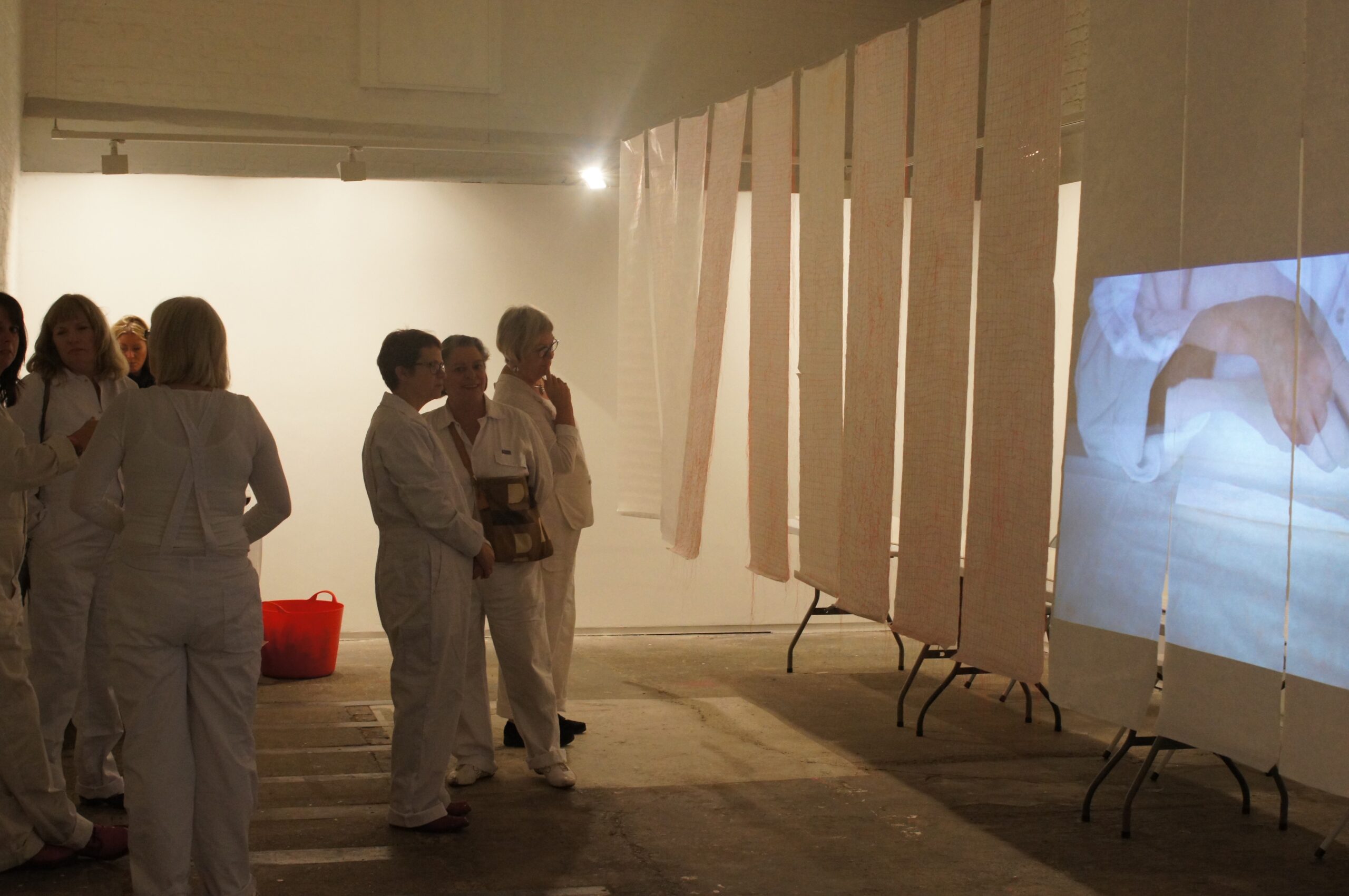
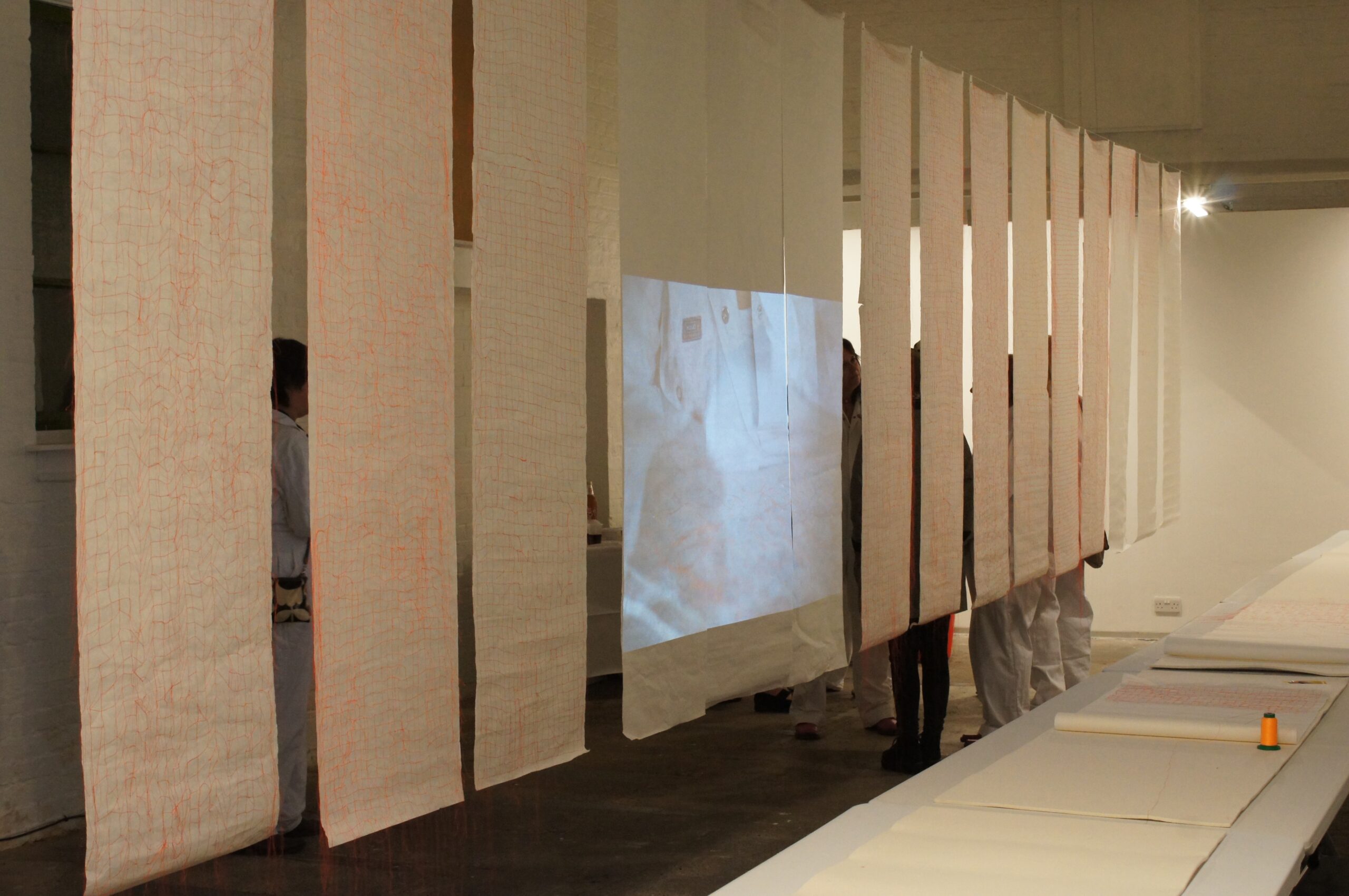
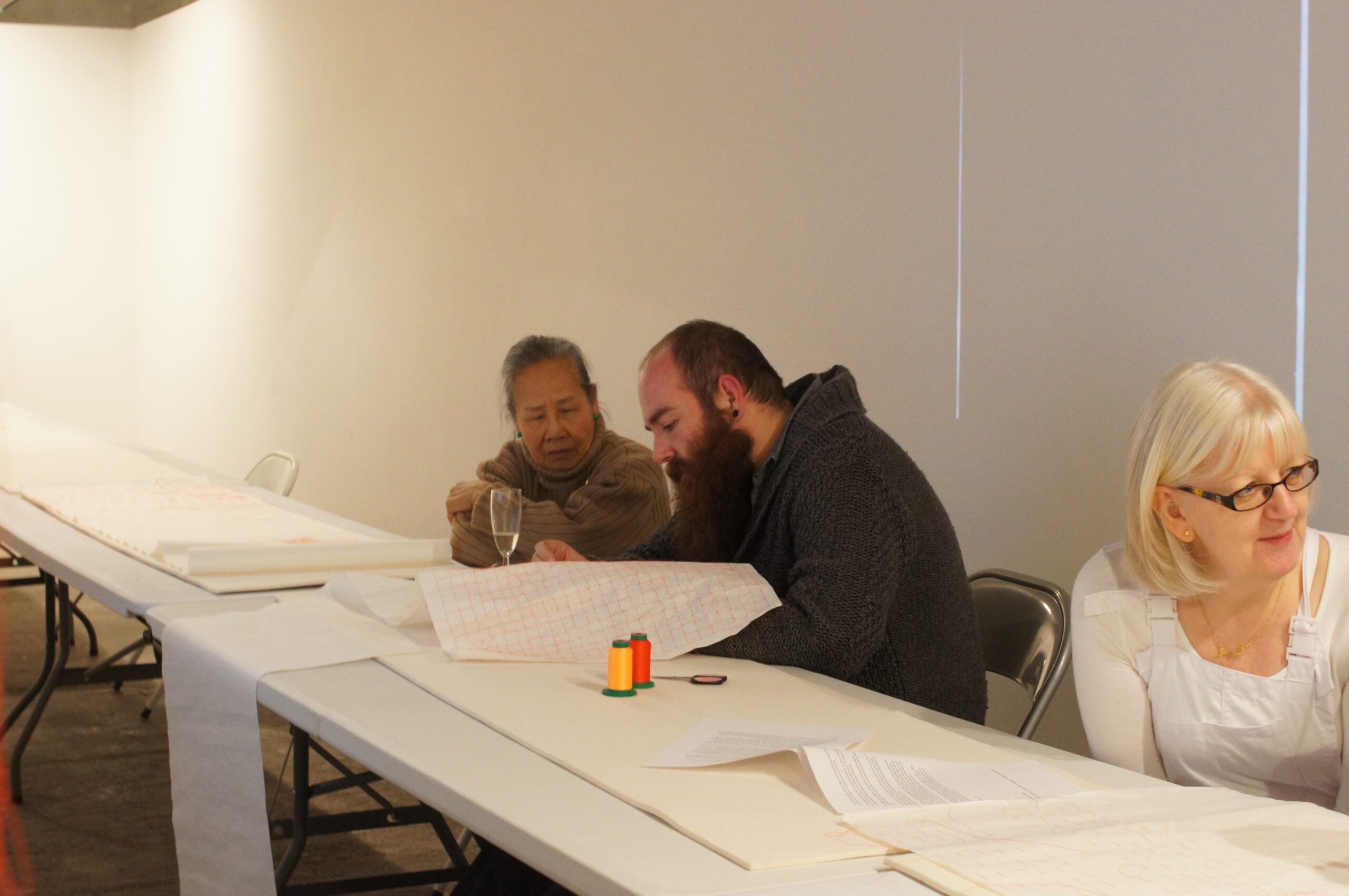
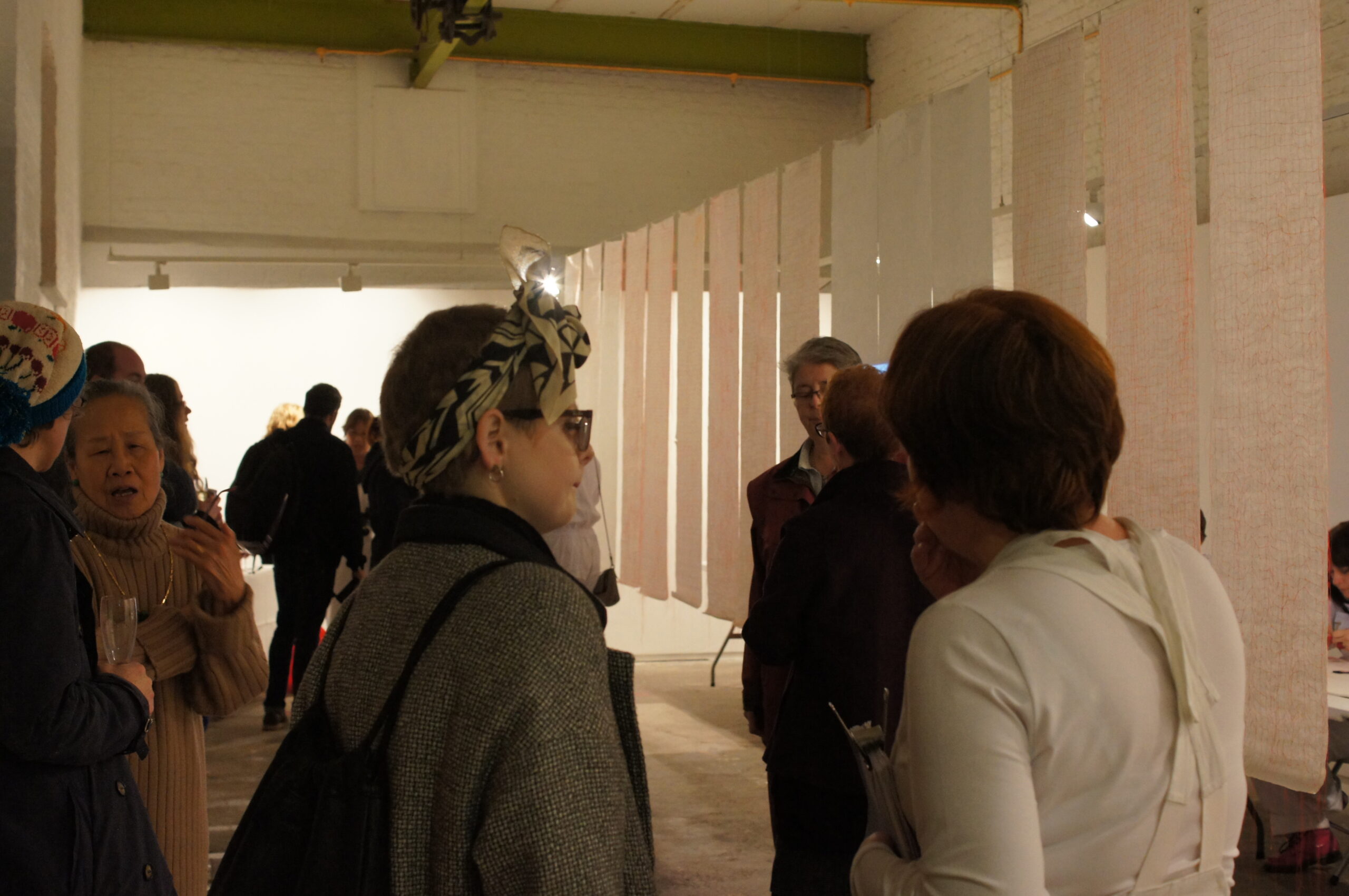
The stitched scrolls were made over several days by eight of us – all women and all artists – working together, at tables set out in a line in our white overalls in an artisan industrial space, namely a former tent and tarpaulin factory in Dover. The wearing of the white workwear made a performative statement of stitching as manual work.
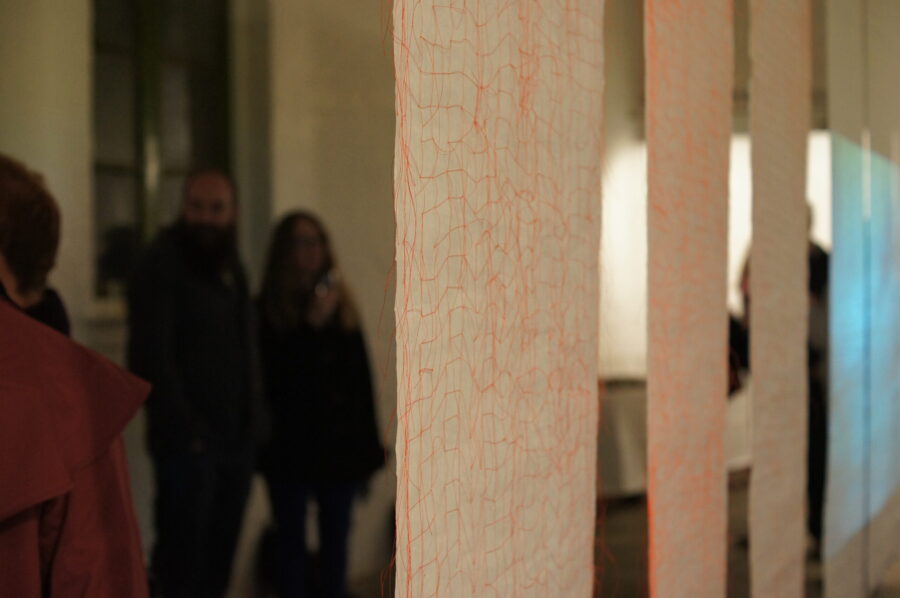
The brief for the project was very simple: each participant was asked to stitch squares onto Chinese calligraphy paper using red thread, without knots and without correcting ‘mistakes’. When the thread got too short to continue, it was left to trail. Not using any knots was an attempt to keep finality at bay. I often use red thread because of the association of red, as the colour of blood, with both life and death.
Not everyone was there every day so inevitably the ‘work rate’ varied. While some were happy for others to pick up from where they left off, others wanted to ‘complete’ a piece themselves.
It became clear very quickly that taking over from where another left off, was not as easy as it might have looked, for each individual had their own rhythm, feel for the thread, length worked with, preferred stitch size and favourite needle, all of which was felt and known with the body and mind rather than the eye.
The making process, suggestive of an assembly line-cum-sewing circle – two different models of working in a shared space – encompassed conversation, laughter and moments of silence, as well as the practised movements of hands at work.
Our conversations moved easily between questions around professional practice and the more personal: relationships, day-to-day events, health… At times they parodied the world of “work”, where work was, in that scenario, seen as “a necessary but unpleasant way to generate revenue”, by suggesting roles such as “foreman”, “employee of the month” (Ruth Payne, for the fastest stitching), “health and safety officer” (Claire Manning), high-flyer (Bev Williams), quality assurance (Rosie James), security officer (Jun Zi the dog), consultant (Joanna Jones), … At other times conversation buzzed with ideas for new projects, solutions to problems, critical reflections on practice, …
And, although initially, the stitching seemed inherently purposeless, even pointless – nothing was being physically stitched together – the stitched scrolls are finally objects, with their inherent demands on how they should be shown, but also multiples with their individual variations – metaphors for the individual within a community – marking the time spent and expressing the individuality of their makers as members of a community formed around the common purpose that is the project.
Clare Smith 2015
With thanks to the artists: Gwen Hedley, Rosie James, Joanna Jones, Claire Manning, Ruth Payne, Linda Simon, Bev Williams
Stitched Time was funded by Arts Council England and shown at:
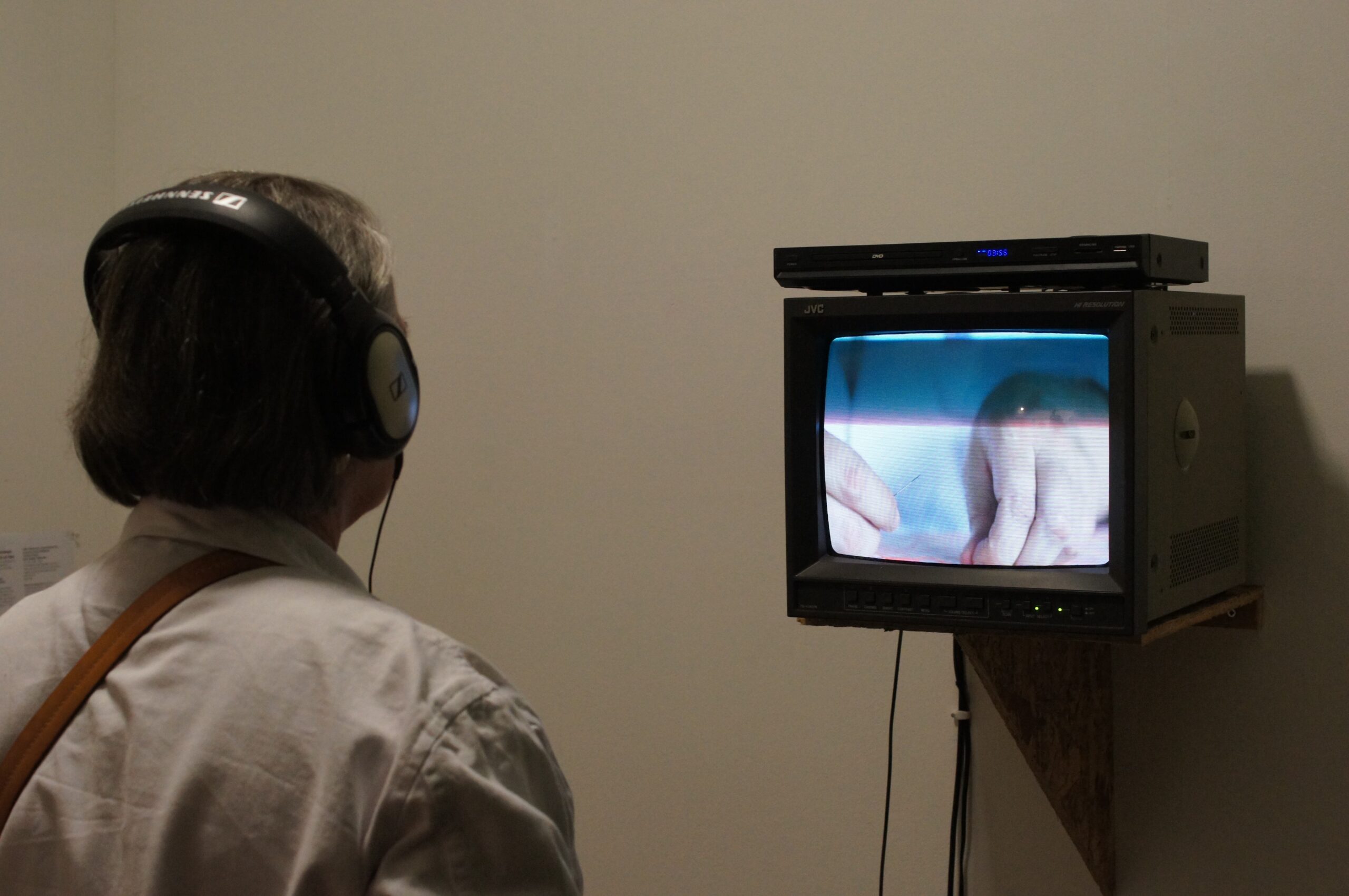
- LIMBO, Bilton Square, Margate, CT9 1EE from 14 November to 23 November, 2014 together with a project video by Ewan Golder
- WOW, Women of the World Festival, Folkestone from 3-7 March 2015
- Drawn Conversations, an exhibition to accompany the Drawing Conversations symposium, ICE Coventry, 4 December 2015