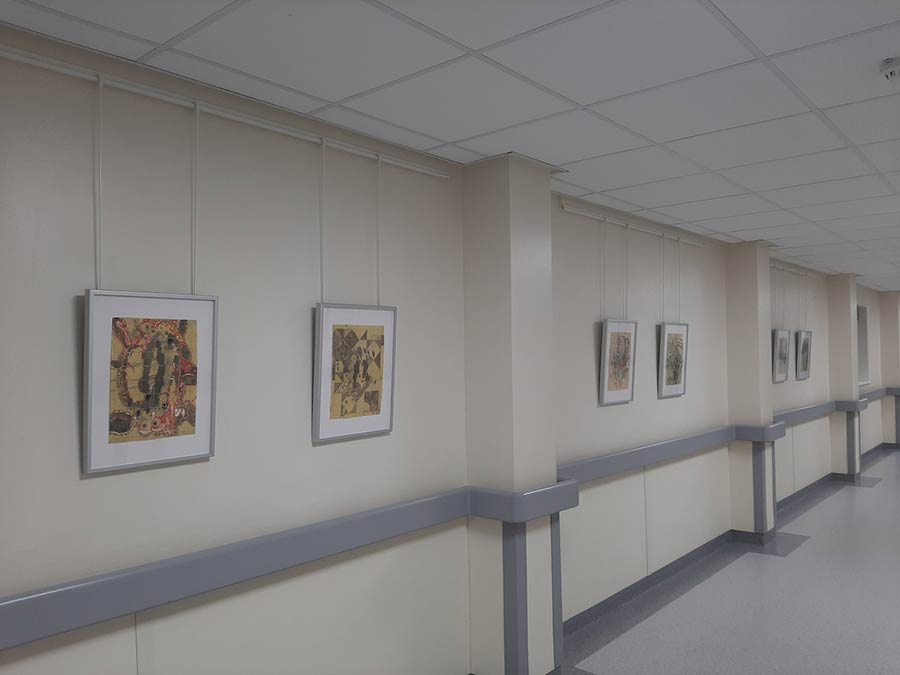
As with any works of art there are some rules surrounding their production, and these rules are generated in two directions; from without – The necessity to remain fairly static for a fixed amount of time – and from within – The artist’s choices and aptitudes. The choice to make drawings suits the physical conditions, the limitations of movement and working space; drawing is also, as it happens, amongst Smith’s preferred ways of making art. Drawing comes naturally to her. Smith has also made the decision, both for practical and for aesthetic reasons, to make them on a particular kind of paper – The rather fragile, inexpensive sheets of pink gridded paper used to practice Chinese calligraphy. The Chinese paper serves as both the material and cultural substrates (cultural because Smith is Anglo-Chinese), as if the paper were like those pads of wetted tissue we used to grow cress on as children. The printed grid offers a set of constraints, either to comply with or to violate. The grid is a trellis – the drawing grows through it, and around it. The pairing of necessity and choice is also evident in the working method. Smith’s work-station resembles a pilot’s cockpit: seated, with a very considerable array of artist’s instruments, pens and pencils and so on, laid out on a side table, and a tray for a work surface in front.
The drawings are abstract, and, mostly, very dense. Abstract, but not non-representational. Far from it. The imagery is rich in associations; one in particular – The drawings can look very much like the sort of thing you might expect to see in a biology textbook or academic journal. The forms are cellular, amoebic, protozoan. This places the work squarely within an art historical context. The visual language of the Chemo day drawings is emphatically the artist’s own, and yet, with its redolence of the imagery generated by the life sciences, it can be seen as a new iteration of an approach that goes back to the origins of abstraction, more than 100 years ago.
For the pioneers of abstraction, particularly Wassily Kandinsky, there were two key sources of imagery. One was associated with the then popular belief systems of Theosophy and Anthroposophy, and the other came with the availability of microscopy, and the possibility of seeing another world, just as real, but ordinarily hidden by virtue of its scale. (The human perceptual apparatus is set to the scale somewhere between an ant and a mountain.) This great visual resource, this access to another order of physical reality, was lent an improbably incorporeal significance for the early exponents of abstraction when understood through the prism of Theosophy (a belief system whose influence on biomorphic and geometric abstraction had been all but forgotten, until the recent art historical reappraisal that has brought key figures like Hilma af Klint to the fore). The Theosophists believed that we generally inhabit only one plane of reality, but are surrounded, invisibly, by many others. The occult world of the microscopic (Antonie van Leeuwenhoek’s ‘animalcules’) supplied a model through which to envisage the space and entities that constitute these other planes of existence. So ‘abstract’ here does not mean ‘non-representational’. The eye piece of a microscope is a portal to an otherwise hidden world of meaning.
Besides biology there is also a sense of cartography, like a child’s map of an island where treasure is hidden. The array of mark-making tools, those versatile new pens that can give both graphic and painterly effects, are tracing the course of a miniature expedition across the picture plane, discovering their own nature as they proceed – What kind of mark does this or that pen want to make? What does it want to do? The artist leads and follows simultaneously.
Smith’s drawings have been compared, informally, to doodles, an association she is not entirely sure of, but it makes some sense; the kind of drawing you do when you both are and are not doing something else – a long meeting at which you do not expect to be called upon to speak, or a phone call during which you are mainly just saying ‘Uh-huh’ every now and then. The longer it lasts the more intricate the drawing becomes, the more likely it is to spread, or for its orientation to alter; the top turns out to be the bottom. The passing of time is logged in the replication and propagation of cellular components. Structures emerge strongly, and then are engulfed or incorporated. A gestural flourish is revised in detail so that it comes to resemble the ornate capital letter of a medieval manuscript. The drawings are decorative and yet diagrammatical, apparently functional but also clearly entirely aesthetic. And they are a record. A process taking place over a given span of time is marked with marks.
Besides their roots in the history of abstraction there are other, more autobiographical, precedents for this body of work, seen as the measured response to an inordinate, profoundly challenging situation – Antonin Artaud’s notebooks, produced in 1945 whilst incarcerated at the asylum in Rodez; Ronald Searle’s war drawings, made whilst he was a POW in Burma. How can we characterise works of art made by an artist who is ill, and which may not have been realised if they had not been? Symptoms? Of course not. Perhaps as a sort of treatment? Art therapy? Not that either. The closest analogy, I would like to suggest, is with alchemy. The process through which base matter is turned in to gold.